
Are pennies worth it? Trump's plan to scrap them didn't come out of nowhere
By: Rachel Treisman
President Trump, whose sweeping agenda aims to dramatically reshape both policy and government, is now aiming at a much smaller target: the 1-cent coin.
Trump announced Sunday night — as he departed the Super Bowl in New Orleans — that he had instructed the secretary of the U.S. Treasury to stop producing new pennies, a practice he called "wasteful."
"For far too long the United States has minted pennies which literally cost us more than 2 cents," he wrote on Truth Social. "Let's rip the waste out of our great nations [sic] budget, even if it's a penny at a time."
That's not just Trump's two cents. The Department of Government Efficiency (DOGE), took aim at the penny in a tweet the day after Trump's inauguration, saying they take over 3 cents to make and cost American taxpayers over $179 million in fiscal year 2023 alone.
Indeed, the penny has what is known as "negative seigniorage," meaning it is worth less than what it costs to produce: 3.69 cents in 2024, according to the U.S. Mint.
Trump announced Sunday night — as he departed the Super Bowl in New Orleans — that he had instructed the secretary of the U.S. Treasury to stop producing new pennies, a practice he called "wasteful."
"For far too long the United States has minted pennies which literally cost us more than 2 cents," he wrote on Truth Social. "Let's rip the waste out of our great nations [sic] budget, even if it's a penny at a time."
That's not just Trump's two cents. The Department of Government Efficiency (DOGE), took aim at the penny in a tweet the day after Trump's inauguration, saying they take over 3 cents to make and cost American taxpayers over $179 million in fiscal year 2023 alone.
Indeed, the penny has what is known as "negative seigniorage," meaning it is worth less than what it costs to produce: 3.69 cents in 2024, according to the U.S. Mint.
The U.S. Mint — a bureau of the Department of the Treasury — said in its annual report that it lost $85.3 million on the nearly 3.2 billion pennies it produced in fiscal year 2024. That was the 19th consecutive fiscal year that the unit cost for pennies has been above face value, it adds.
The value of keeping the nation's smallest-value coin has been a decades-long debate — even former President Barack Obama expressed his support for eliminating pennies in a 2013 interview.
"This is not going to be a huge savings for government, but anytime we're spending more money on something that people don't actually use, that's an example of something we should probably change," Obama said.
The idea is popular among many economists and has been raised before in Congress. But as with several of his recent directives, it's not clear that Trump has the authority to do so by himself.
The value of keeping the nation's smallest-value coin has been a decades-long debate — even former President Barack Obama expressed his support for eliminating pennies in a 2013 interview.
"This is not going to be a huge savings for government, but anytime we're spending more money on something that people don't actually use, that's an example of something we should probably change," Obama said.
The idea is popular among many economists and has been raised before in Congress. But as with several of his recent directives, it's not clear that Trump has the authority to do so by himself.
Can Trump do it?
It is Congress that oversees the Mint's operations and authorizes the manufacturing of coins, as well as many medals."As a part of the U.S. Department of Treasury, the United States Mint derives its authority from the United States Congress," reads the agency's website.
The E. Barrett Prettyman U.S. Courthouse in Washington, D.C., in 2023. Treasury Secretary Scott Bessent has not commented publicly on the president's directive.
The consensus seems to be that it would take an act of Congress to stop minting pennies, though there may be some gray area.
"The process of discontinuing the penny in the U.S. is a little unclear," said Northeastern University professor Robert Triest in a January news release. "It would likely require an act of Congress, but the secretary of the Treasury might be able to simply stop the minting of new pennies."
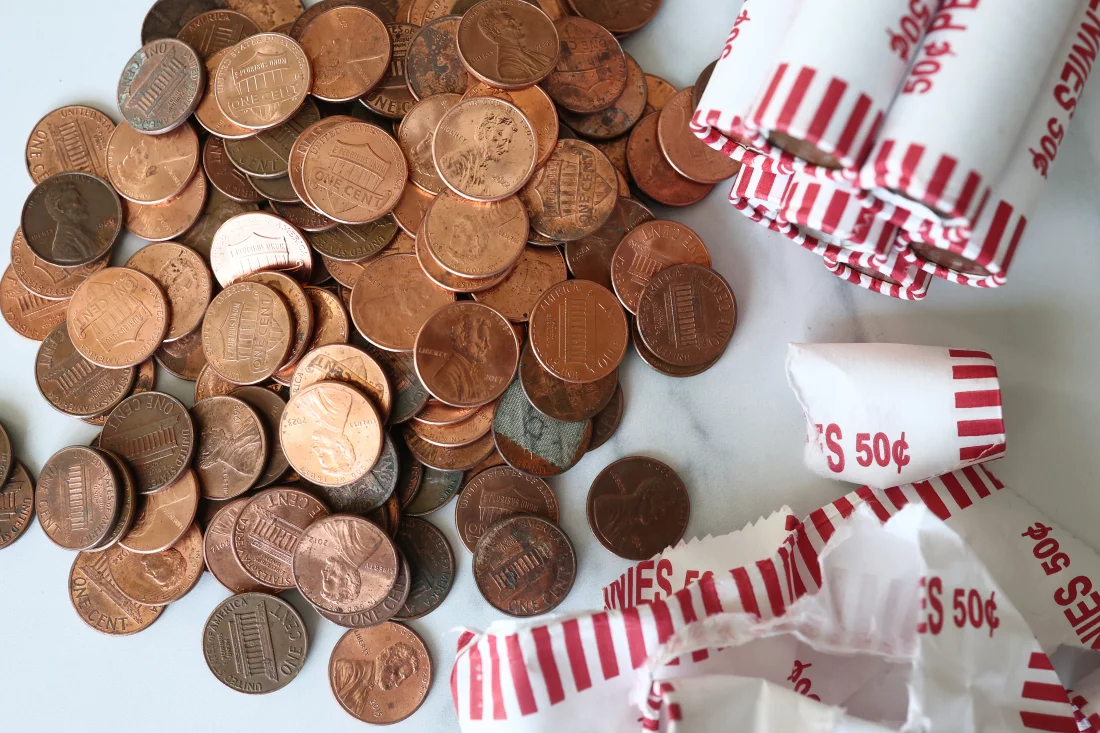 Michael M. Santiago/Getty Images